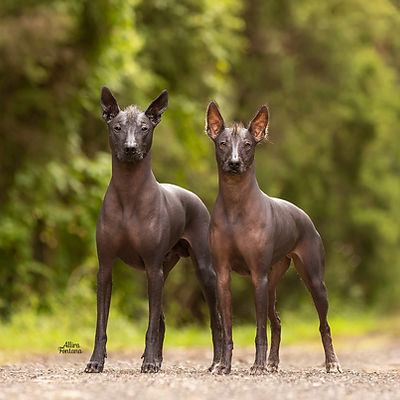
Health Screening
The Xoloitzcuintli is generally a healthy, resilient breed and is often blessed with a longer lifespan (13-15 years). Like all dogs, Xolos are not immune to illness or disease; however, some health conditions can be more relevant to certain breeds. For this reason, responsible breeders follow recommended health screening protocols when selecting dogs for breeding.
Eye Examination by an Ophthalmologist
For standard-size Xoloitzcuintli, an eye examination performed by a veterinary ophthalmologist is recommended prior to breeding - this screening can be undertaken at any age. This screening is used to identify heritable or potentially heritable eye conditions, even though the breed is not currently associated with a high incidence of inherited ocular disease.
Most conditions assessed during an ophthalmologist examination are low prevalence in standard Xolos. The purpose of testing is therefore preventative rather than corrective - serving as a safeguard to protect the breed’s long-term health, not because the Xolo is considered eye-problem prone. Despite the absence of widespread inherited eye disease in the breed, ophthalmologist screening remains:
-
Preventative
-
Responsible
-
Breed-preserving
Conditions Typically Screened For
-
Progressive Retinal Atrophy (PRA)
-
Cataracts (particularly juvenile or inherited forms)
-
Distichiasis / Ectopic Cilia
-
Persistent Pupillary Membranes (PPM)
-
Retinal Dysplasia
-
Optic Nerve and Fundus Abnormalities
-
Keratoconjunctivitis Sicca (Dry Eye) – observational
An eye certificate will be issued at this screening to show findings. Our breeding dogs have been given the all clear in their screening, and this certificate is available to puppy buyers to view.
Cardiac Evaluation
The standard Xoloitzcuintli is widely regarded as a healthy breed with no known high incidence of inherited heart disease. That said, responsible breeders choose to include cardiac screening as part of their health testing program to help protect the long-term wellbeing of the breed. Some heart conditions are congenital, meaning a dog can be born with them even if they appear completely healthy and show no outward signs.
These conditions can be difficult to detect during routine veterinary visits and may only be identified through specific cardiac screening. While such issues are uncommon in Xolos, screening helps ensure they are not unknowingly passed on to future generations.
Because Xolos have a relatively small global breeding population, preventative testing plays an important role in maintaining breed health.
Cardiac evaluations provide reassurance that breeding dogs have normal heart function at the time of testing and allow breeders to make informed, responsible decisions.
For puppy buyers, cardiac testing offers peace of mind. It reflects a commitment to transparency, thoughtful breeding, and preserving the Xoloitzcuintli as the robust, long-lived breed it is known to be - now and into the future.
A heart certificate will be issued at this screening to show findings. Our breeding dogs have been given the all clear in their screening for breeding, and this certificate is available to puppy buyers to view.
Hip, Elbow & Orthopaedic Screening (Health Elective)
The Xoloitzcuintli is an active, athletic breed, and maintaining good joint health is an important part of responsible breeding. While orthopaedic screening is listed as a health elective, we choose to take a proactive approach and screen all of our breeding dogs, not just for hips but also for elbows.
Hip evaluations - performed through recognised programs are used to assess hip structure and stability.
These screenings help identify dogs with sound joints and reduce the likelihood of passing on structural weaknesses that could affect comfort, mobility, or quality of life later on.
While hip dysplasia is not considered common in Xolos, screening helps ensure it remains uncommon. Elbow screening is included for similar reasons.
A Hip & Elbow certificate will be issued at this screening to show findings. Our breeding dogs have been shown not to have hip & elbow issues, and this certificate is available to puppy buyers to view.
Elbow issues, when they occur, can significantly impact movement and long-term comfort. Even in breeds where elbow disease is rare, screening provides valuable reassurance and supports careful, informed breeding decisions.
It is also important for puppy buyers to understand that hip dysplasia is a polygenic condition, meaning it is influenced by multiple genes rather than a single inherited trait. Because of this complexity, there is no simple genetic test and no breeder, no matter how responsible or experienced, can guarantee that hip dysplasia will never occur.
Even when both the sire and dam have good hip scores, it is still possible for a puppy to develop the condition. In addition to genetics, environmental factors play a well-documented role in how hip dysplasia develops.
Studies have shown that factors such as growth rate, body condition, nutrition, exercise during development, and overall management during puppyhood can significantly influence joint health.
Rapid growth, excess weight, inappropriate exercise, or overfeeding during key developmental stages can increase risk, even in genetically well-selected dogs. For this reason, health testing should be viewed as a way to reduce risk rather than eliminate it, and responsible breeders also place strong emphasis on education and ongoing support for puppy buyers.
By combining careful genetic selection with appropriate puppy management, we aim to give each puppy the best possible foundation for long-term soundness and quality of life.
DNA Testing for Genetic Diseases
We conduct DNA testing through Embark Vet in the United States, using a saliva sample to screen for over 200 known genetic diseases found across all dog breeds. This testing helps us make informed breeding decisions and reduce the risk of inherited disease.
We do not breed dogs that are genetically affected by any of the conditions tested, meaning we do not knowingly produce puppies that could develop these diseases.
Dogs identified as carriers may still be bred responsibly to dogs that are clear of the same condition. When done correctly, this approach is considered safe, as it does not produce affected puppies, while also helping preserve genetic diversity within the breed. These test results are available to puppy buyers.
Full Blood Panel
All of our breeding dogs undergo a full blood panel with their general practice veterinarian prior to breeding to ensure they are healthy and free from underlying issues, such as thyroid disease or other systemic concerns.
As part of our ongoing health management, we typically run full blood panels annually, and in senior dogs, this may be done once or twice yearly. This proactive monitoring helps us maintain the overall health of our dogs and ensures they are in optimal condition before being bred. These test results are available to puppy buyers.
Pet insurance is a responsible way forward for puppy buyers, for when nature happens.
Temperament testing
Our breeding dogs are assessed by a professional trainer experienced with primitive breeds, providing us with an objective and unbiased evaluation of each dog’s temperament. We do not breed dogs with unstable temperaments, as doing so is unfair both to the dogs produced and to the families who welcome them into their homes.
It is also important to understand that every litter will display a range of personalities, and that a puppy’s environment, handling, and life experiences play a significant role in shaping their future behaviour. For this reason, we are committed to offering puppy families a high level of ongoing support in puppy raising and training, should they wish to access it.
Our goal is to help each puppy develop into a confident, well-adjusted companion.
Those new to Xolos must understand they are a primitive dog, and there are behavioural differences in play - they must be well trained and well socialised to be good companions, lazy parenting isn't going to work here, and neither is treating them like a baby, they will turn them into an entitled and problematic dog. Xolos must have rules and boundaries and owners who will be consistent with them.
